
Select your language

For local governments
Why should public transport run on B100 biodiesel?
Support for eco-friendly vehicles in public transport is regulated by Directive 2009/33/EC of the European Parliament and the Council and Act No. 214/2021 Coll. on the Support of Eco-Friendly Road Transport Vehicles. This act also sets requirements for the minimum representation of eco-friendly vehicles in the M3 category and trolleybuses in the reference period from January 1, 2026, to December 31, 2030, at 48%.
Biofuels bring significant environmental and economic benefits: They reduce CO₂ emissions in transport and help meet EU environmental commitments, while reducing dependence on oil imports and being more cost-effective than other alternative fuels. They are produced from Slovak crops and waste, supporting the domestic agricultural sector, creating jobs in rural areas, and significantly boosting the local economy. Additionally, high-value animal feed is produced as a by-product of biodiesel production, increasing the efficiency of the entire production chain.
Is B100 safe for the engines?
B100 biodiesel offers a simple and immediately available way to reduce the carbon footprint without the need to invest in new infrastructure. Thanks to the EN 14214 standard, it offers stable, proven quality and excellent lubricating properties, and has been safely used throughout the EU for over fourteen years. However, an engine designed to run on B100 fuel is required.
Where Is B100 successfully used?
B100 fuel is widely used in Scandinavian countries. Entire fleets (around ten thousand vehicles) are also operating in France, which boasts a developed refuelling infrastructure. In neighbouring Austria, biofuel producer Münzer operates its own fleet. B100 is available at public fuel stations in Germany, Italy, the Netherlands, Spain, Portugal, and other countries. Since biodiesel is a safe, years-tested alternative to fossil diesel, the list of countries is constantly expanding.
Availability of B100-powered buses
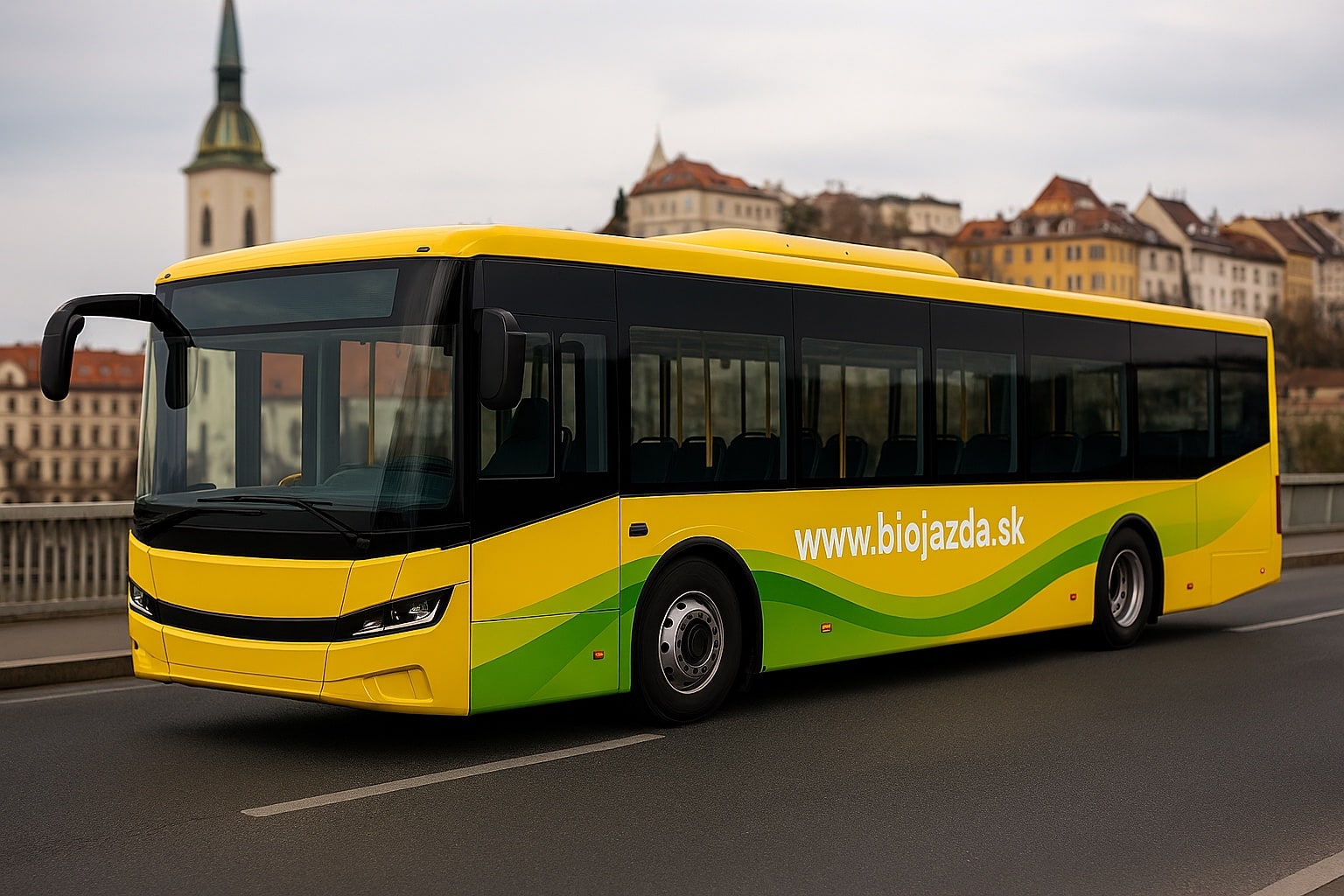
Buses running on B100 fuel represent an effective and sustainable way to modernize fleets without the need to invest in new infrastructure. Renowned manufacturers such as IVECO and MAN offer a wide range of urban and suburban configurations, and the vehicles meet the criteria for eco-friendly transport vehicles under current legislation (Act No. 214/2021 Coll. on the Support of Eco-Friendly Road Transport Vehicles). Driving B100 guarantees reliable performance even in hilly terrain, with refuelling and storage under the same conditions as with fossil diesel, without the need to build new charging or filling infrastructure, while offering fuel consumption and range comparable with fossil diesel. For transport companies, adopting B100 is an ideal measure to quickly and elegantly reduce their carbon footprint without complex changes in operations. The price difference relative to the diesel configuration is minimal, usually not exceeding around 2,000 euros.
Call for grants: Program ‘Slovensko’ for municipalities and cities: Support for the development of sustainable mobility
Code of the call for grant proposals: PSK-MD-002-2024-ITI-EFRR
Allocated Funds: 350 million euros
Call for grants announced by the Ministry of Transport of the Slovak Republic in April 2024.
Eligible activities include:
- Renewal and modernization of rail public transport vehicles and vehicles for intracity public transport and suburban transport, i.e., buses with alternative drives, including related filling and charging infrastructure—electric energy, hydrogen, biofuels, and CNG.
- Grants can only be provided for buses with alternative drives: electric energy, biofuels, CNG, H2.
How does use of biodiesel impact vehicle operations and service?
The operation of buses running on B100 biodiesel is comfortable, predictable, and fully compatible with existing processes: Refuelling, maintenance, and operation do not in any way differ from conventional diesel, allowing for immediate switch to B100 without investing in infrastructure. The fuel is stable even in demanding winter conditions, as it is supplied with seasonal additives, CFPP down to −10 and −20 °C. Vehicle manufacturers only require slightly shorter service intervals to ensure optimal fleet reliability. B100 is stored under the same conditions as conventional diesel, and although it is not available at public fuel stations throughout Slovakia, operators can easily use their own dispenser or rent above-ground fuel tanks. For companies, this means a fast, elegant, and economically effective path to more sustainable operations without unnecessary intermediate steps.
Did you not find the answer to your question?
Are you interested in learning more? Are you considering implementation of biodiesel in your company fleet?
Write to us at info@biojazda.sk or use the contact form below.